
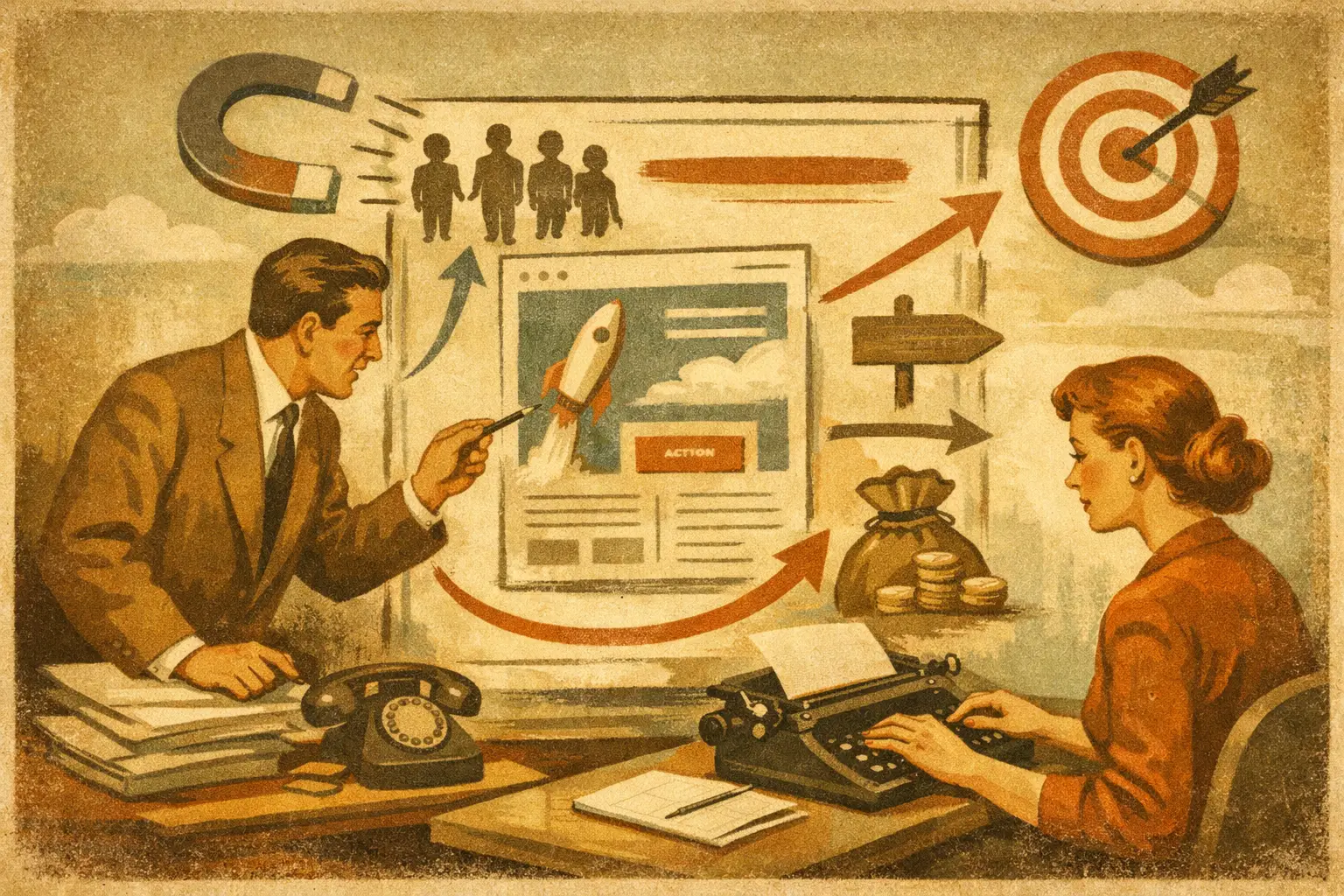
A lot of landing pages fail before the visitor even scrolls.
Not because the design is ugly. Not because the ad was terrible. They fail because the page asks the visitor to do mental work. Figure out the offer. Guess the next step. Hunt for proof. Translate vague marketing language into a real business outcome.
That friction kills conversions.
If you want to know what makes a high converting landing page, start here: the best pages are brutally clear, tightly focused, and built to move one specific person toward one specific action. Not impressed. Not entertained. Converted.
A high converting landing page makes the decision easy.
That sounds simple, but most businesses overcomplicate it. They cram in extra services, generic claims, stock-photo smiles, and buttons that say things like “Learn More” when what they really want is a lead. Then they wonder why traffic bounces and ad spend disappears.
A landing page that converts does a few things exceptionally well. It matches the visitor’s intent, communicates value fast, removes doubt, and creates momentum. Every section should answer one of the questions running through the visitor’s head: Am I in the right place? Is this relevant to me? Why should I trust you? What happens if I take the next step?
When those answers are obvious, conversion rates improve. When they are buried under fluff, they don’t.
The biggest mistake on landing pages is disconnect.
Someone clicks an ad about emergency dental appointments, tax planning for small businesses, or local roofing estimates – and lands on a page that talks in broad, generic terms about “innovative solutions” and “quality service.” That’s a fast way to lose the click you paid for.
High-converting pages continue the conversation the visitor already started. If the ad, email, or search result promised a specific offer, the landing page needs to repeat and sharpen that promise. Same pain point. Same audience. Same outcome. Stronger detail.
This is where a lot of businesses leak money. They spend time optimizing campaigns while sending traffic to pages that feel one step removed from the original intent. That gap hurts trust. It also hurts response.
The fix is straightforward. Lead with the exact problem and outcome the visitor cares about. Not your company history. Not a broad list of everything you do. The offer first.
The headline should answer: what is this, who is it for, and why should I care?
That’s it.
It does not need to sound clever. Clever headlines are often expensive because they trade clarity for style. A visitor should be able to understand the page in seconds without scrolling. If they have to interpret the headline, you’ve already introduced resistance.
A strong headline is specific. It points to a result. It reflects the traffic source. It sets the tone for the rest of the page.
The subheadline then earns its keep by adding context. Maybe it explains how the offer works, who it helps, or what makes it different. This is where good pages separate themselves from weak ones. They don’t just make a claim. They make the claim believable.
A landing page is not your homepage.
That distinction matters. A homepage has to serve multiple audiences and multiple pathways. A landing page should do the opposite. It should narrow focus.
If the page tries to get the visitor to book a call, download a guide, watch a video, browse services, follow on social, and read three case studies, it is not focused. It is distracted. Distracted pages convert like distracted salespeople.
The highest-performing landing pages are built around one primary conversion goal. Fill out the form. Book the consultation. Request the quote. Start the application. Whatever the action is, the page should support it from top to bottom.
That doesn’t mean every page has to be minimal. Some offers need more explanation than others. A high-ticket service usually needs stronger proof and more objection handling than a low-friction lead magnet. But even on longer pages, the goal stays singular.
Visitors are always making a trade.
You’re asking for their time, attention, contact information, or commitment. In return, they need a clear reason to act now instead of later. That reason is your offer.
This is where weak landing pages usually fall apart. They ask for too much while offering too little. A “contact us” form with no real value proposition is not an offer. It’s a chore.
A strong offer has a concrete benefit attached to it. It promises a useful next step, a clear outcome, or a fast path to clarity. For service businesses, that might be a strategy call, audit, estimate, assessment, or consultation. What matters is that the visitor understands what they get and why it matters.
Specificity helps here. So does immediacy. “Get a custom growth plan” is stronger than “Submit your information.” People respond to progress, not process.
Good design supports conversion. It doesn’t win on aesthetics alone.
A high-converting landing page is easy to scan, easy to understand, and easy to act on. The layout should guide attention, not compete for it. Strong hierarchy, clean spacing, readable text, clear buttons, and mobile-friendly structure all matter because they reduce friction.
But design is not decoration. A beautiful page with weak messaging still loses.
This is why businesses get frustrated after expensive redesigns. They improve the visual layer without fixing the sales layer. The page looks more modern, but the headline is still vague, the offer is still weak, and the form still asks for too much.
The best landing pages make the next step obvious. Calls to action are visible without being obnoxious. Important information appears in the right order. Forms are short unless there is a strong reason to qualify harder.
There is always a trade-off here. Shorter forms usually increase lead volume. Longer forms can improve lead quality. Which one is right depends on your sales process, follow-up speed, and capacity. This is why conversion rate alone never tells the whole story.
Most visitors arrive skeptical. That’s normal.
They don’t know you yet. They don’t know whether your claims are real. They don’t know if filling out the form leads to a helpful conversation or a spam storm.
Trust signals reduce that uncertainty.
The strongest proof is concrete proof. Real testimonials with specific outcomes. Case study snippets. Recognizable client logos if they are relevant. Certifications, guarantees, years of experience, media mentions, before-and-after examples, or process transparency if that helps your audience feel safer.
Generic praise doesn’t do much. “Great service” is fine, but it won’t move the needle like a testimonial that says, “We doubled qualified leads in 90 days and finally had a website that converted paid traffic.”
Trust also comes from honesty. If your service is not right for everyone, say that. If results depend on traffic quality, follow-up, or market conditions, acknowledge it. Buyers trust pages that sound like they understand reality, not pages that sound like they were written by a hype machine.
A lot of conversions are lost because the page leaves obvious questions hanging.
What happens after I submit? How long will this take? Is this customized or cookie-cutter? Is this right for my type of business? Do I need a big budget, a new website, or a full rebrand first?
You don’t need a giant FAQ section to handle objections. Often, a few well-placed sentences throughout the page do the job better. Explain the process. Set expectations. Clarify who the offer is for. Reduce uncertainty.
This is especially important for service businesses selling real growth outcomes, not impulse purchases. When the next step involves a conversation, buyers need to know they’re not walking into a vague sales pitch. They want clarity and accountability.
That is one reason founder-led, hands-on positioning works so well when it’s true. It tells prospects they won’t be dumped into a generic system and forgotten. For the right audience, that matters.
The truth is, no landing page is perfect on launch.
You can make all the right strategic decisions and still need testing. Sometimes the offer is right but the headline is too soft. Sometimes the page converts, but the lead quality is poor. Sometimes mobile performance tanks results. Sometimes trust signals are too low on the page to help.
The businesses that win treat landing pages like sales assets, not finished artwork. They track form submissions, call volume, booked appointments, lead quality, and downstream revenue. Then they adjust.
That might mean rewriting the hero section, tightening the CTA, reducing form fields, adding stronger proof, or changing the section order. Small changes can create meaningful lifts when the page already has solid traffic.
This is where integrated marketing matters. A landing page does not convert in isolation. Traffic source, offer quality, audience targeting, follow-up speed, and sales process all affect performance. If your ads are attracting the wrong clicks, the page will struggle. If your team takes two days to respond to leads, the page will look worse than it is.
That’s why smart businesses stop asking whether the page alone is the problem. They look at the whole funnel.
A high-converting landing page is not magic. It is clear messaging, a relevant offer, smart structure, real proof, and less friction than the alternatives. If your page is underperforming, the answer usually is not more fluff. It is sharper thinking, better alignment, and a page that sells as hard as you do.
