
A website that looks fine but fails to convert is not a business asset. It is a brochure with hosting fees. That is the real issue behind the custom website vs template debate – not aesthetics, but whether your site actually helps generate leads, book calls, and move revenue.
If you are a business owner trying to grow, this choice matters more than most agencies admit. Templates are fast. Custom websites are flexible. But speed means very little if your site cannot support your sales process, your traffic strategy, or the way your buyers make decisions. The right answer depends on where your business is now, how you sell, and how serious you are about growth.
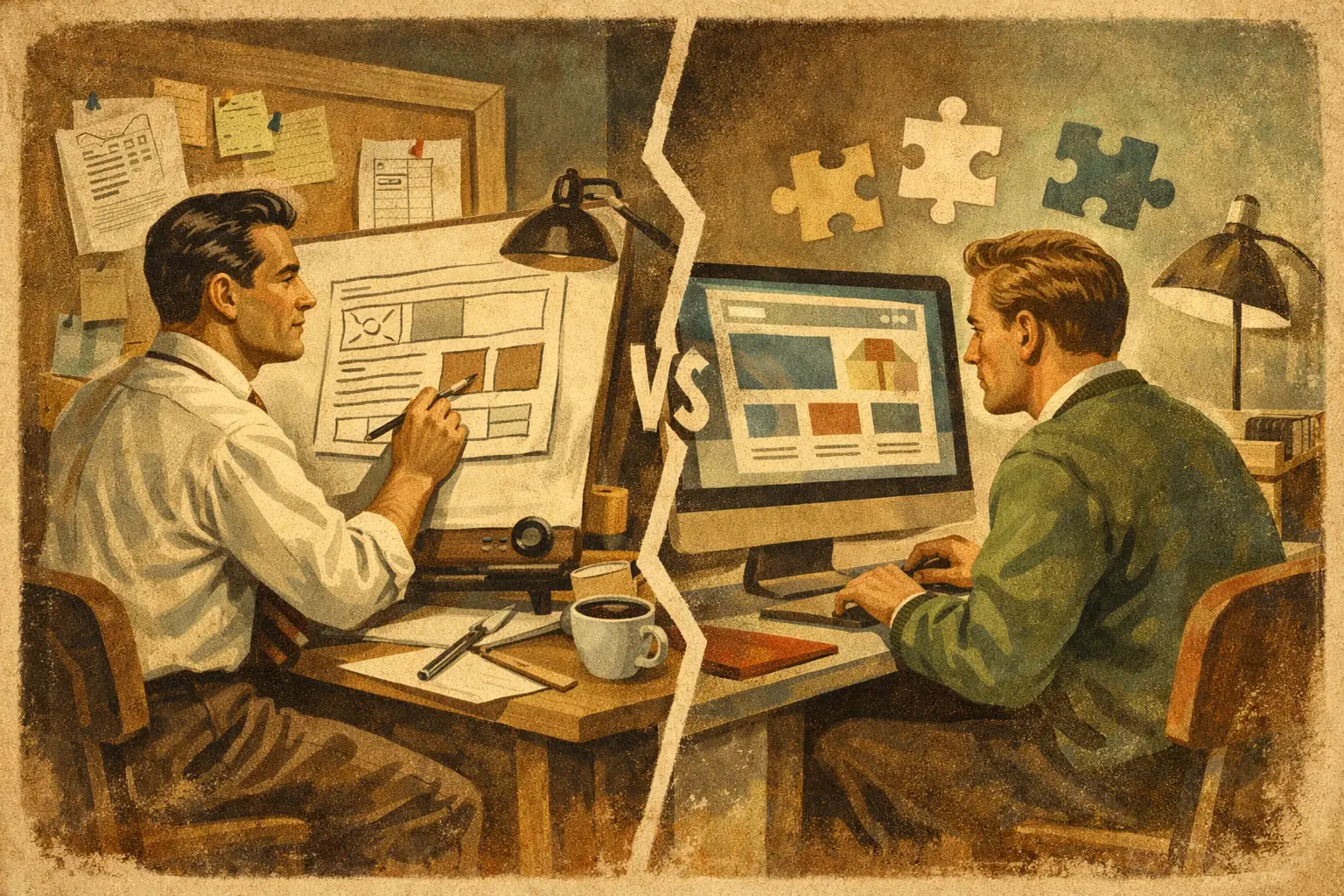
On paper, the difference seems obvious. A template website starts with a pre-built layout. You swap in your brand, your copy, your images, and publish. A custom website is built around your business goals, your user journey, and the actions you want visitors to take.
In practice, the gap is bigger than that.
A template gives you a design system that was made for everyone. A custom website gives you a sales system built for your specific business. That affects everything from page structure and messaging hierarchy to speed, search visibility, lead capture, trust signals, and how easy it is to scale later.
That does not mean templates are useless. It means they solve a different problem. They help businesses get online quickly. They do not automatically help businesses compete harder or convert better.
There are situations where a template is the smart move.
If you are launching a new business and need a clean web presence fast, a strong template can do the job. If your offering is simple, your traffic volume is low, and your immediate goal is credibility rather than aggressive lead generation, you may not need a fully custom build yet.
Templates also work better when your website plays a limited role in the sales process. For example, if most of your business comes from referrals, repeat customers, or offline relationships, your site may only need to validate trust, explain services, and provide a clear contact path.
The key is honesty. A template is fine when your needs are straightforward. It becomes a problem when your business outgrows it but your site does not.
Most template-based websites break down in the same places.
First, they force your business into someone else’s structure. Maybe the homepage puts emphasis in the wrong place. Maybe your service pages are too shallow. Maybe the mobile experience looks decent but buries the call to action. These sound like small issues until you realize they are shaping every visitor’s decision.
Second, templates tend to create sameness. Your business may be different, but your site feels familiar in the worst way. Buyers have seen the same hero section, the same icon rows, the same generic layouts. That weakens trust, especially if your market is crowded and your customer is comparing options quickly.
Third, templates often make growth harder. Adding custom functionality, improving page flow, refining conversion paths, or creating content structures that support SEO can become clunky fast. You can patch things together for a while. Then one day you realize your website is fighting your marketing instead of supporting it.
That is where many businesses get stuck. They built a website to check the box, and now the box is costing them leads.
A custom website gives you control where it counts.
Instead of asking, “How do we make our business fit this layout?” you ask, “What does this buyer need to see to take action?” That shift changes the entire build. Messaging gets tighter. Navigation gets cleaner. Service pages can speak directly to search intent. Forms, calls to action, proof elements, and trust signals can be placed where they actually influence conversions.
This matters if your website is supposed to be a 24/7 salesperson rather than a digital business card.
A serious growth strategy needs a site that supports traffic from multiple channels. Organic search visitors need content depth and page relevance. Paid traffic needs focused landing experiences. Referral traffic needs trust fast. Returning visitors need friction removed. A custom website is built with those realities in mind.
It also gives you room to improve over time. You are not boxed into a rigid framework every time you want to test a different call to action, expand service pages, add location-specific content, or tighten your funnel.
For small and midsize businesses trying to generate predictable growth, that flexibility is not a luxury. It is part of the system.
This is where the decision gets practical.
A template can be optimized for SEO. It can rank. It can convert. Anyone claiming otherwise is selling fantasy. But a custom website usually gives you more control over the factors that actually move performance.
You can create cleaner page architecture, stronger internal content structure, better speed optimization, more intentional heading hierarchy, and page layouts built around specific search behavior. More importantly, you can align content and conversion instead of treating them like separate jobs.
The same goes for conversion rate optimization.
With a template, you are often limited by preset blocks and design logic. With a custom site, you can shape each page around the actual decision-making process of your buyers. That means addressing objections earlier, showcasing proof in the right places, making next steps obvious, and reducing drop-off where it usually happens.
If your business depends on steady lead flow, those details are not cosmetic. They directly impact revenue.
Custom is not automatically better just because it is custom.
A poorly planned custom website can become bloated, confusing, and slow. If the strategy is weak, the extra freedom does not help. You just end up with a more expensive version of the wrong thing.
On the flip side, a well-chosen template with sharp copy, strong branding, and a clear conversion path can outperform a lazy custom build every day of the week.
That is why the real comparison is not custom website vs template in a vacuum. It is strategic custom build vs generic setup. If there is no serious strategy behind the website, the format alone will not save it.
This is also where founder-led, hands-on execution matters. Too many businesses get sold a polished process and receive a site that looks nice but has no clear performance logic behind it. QVM Digital Marketing takes the opposite approach – build around what drives traffic, leads, and sales, then make every page earn its place.
Start with one blunt question: is your website supposed to support growth, or just exist?
If you only need a presentable online presence for now, a template may be enough. If your services are simple, your competition is light, and your site is not a major sales driver, keep it lean and avoid overbuilding.
But if you are investing in SEO, running ads, building brand authority, or trying to improve conversion rates, your website cannot be treated like an afterthought. In that case, custom usually makes more sense because your site needs to do more than look professional. It needs to guide action.
You should also look at how unique your sales process is. Do customers need education before they convert? Do you offer multiple services with different intent paths? Do trust, proof, and positioning play a major role in closing deals? If yes, a custom structure gives you more control over the path from visit to inquiry.
And think ahead. If your business grows the way you want it to, will your current website support that momentum or slow it down?
That is the question that tends to settle the argument.
For businesses that want steady, trackable growth, custom usually wins. Not because it sounds premium, but because it gives you the freedom to build around how your business actually sells.
Templates are useful when speed and simplicity matter most. Custom websites are stronger when performance matters most. That is the trade-off.
If your site is one of the main ways people discover you, evaluate you, and contact you, then it should be built with intention. Not assembled from default sections and crossed fingers.
Your website does not need to be flashy. It needs to be effective. If it can bring in the right traffic, build trust fast, and turn interest into action, it is doing its job. If it cannot, the design method is the least of your problems.
Choose the option that matches the role your website needs to play today – and the level of growth you plan to demand from it tomorrow.
A weak website or invisible search rankings are lost opportunities. We turn your traffic into measurable revenue with high-performance digital strategies.
Connect With Our Experts218 Henderson Hwy
Winnipeg, MB, Canada
A weak website, low engagement, or invisible search rankings aren’t just problems—they’re lost opportunities. At QVM, we build high-performance websites, results-driven SEO, and content that actually converts.
Connect and discuss