
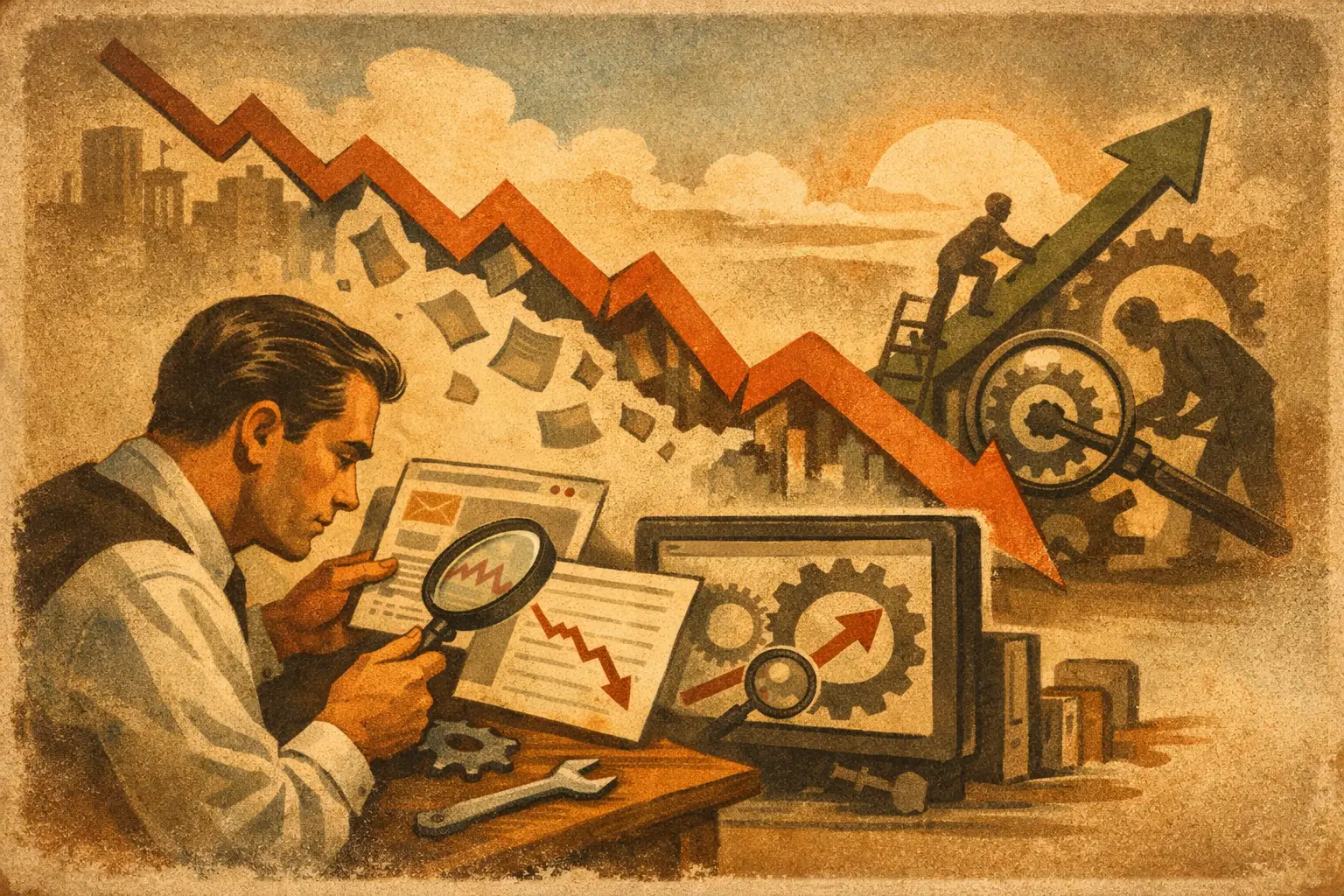
A traffic drop rarely shows up politely. It usually hits when leads slow down, sales calls get quieter, and someone on your team starts asking whether SEO “still works.” That is exactly why SEO recovery after traffic drop has to start with facts, not panic. If you react too fast, you can make a bad situation worse.
The hard truth is this: not every drop means Google penalized you, and not every recovery starts with new content. Sometimes the problem is technical. Sometimes rankings are intact but click-through rate collapsed. Sometimes traffic fell because the wrong pages were carrying the site in the first place. If you want the traffic back, and you want it to turn into revenue, you need a clean diagnosis before you touch anything.
First, pin down when the drop happened. Not “sometime last month.” Get specific. Was it overnight, over a week, or a slow slide over three months? That single detail changes the investigation.
A sharp decline usually points to a technical issue, a site change, deindexing, tracking errors, or an algorithm update. A gradual decline often means competitors improved, content got stale, links weakened, or search intent shifted. Those are very different problems, and they do not get solved with the same playbook.
Look at organic traffic by landing page, not just sitewide totals. If only blog traffic dropped, the issue may be informational content quality or a change in how Google treats that topic. If service pages took the hit, that is more serious because it usually affects leads directly. If branded traffic is steady but non-branded traffic is down, your visibility problem is broader than customer awareness.
That is the first rule: isolate the loss before you try to recover it.
Plenty of businesses think they lost rankings when what they really lost was tracking accuracy. Analytics setups break all the time after redesigns, CMS migrations, tag changes, cookie banner updates, or form tool swaps.
Before declaring an SEO emergency, verify that organic sessions, conversions, and landing page attribution are being tracked correctly. Check Search Console against analytics. If Search Console clicks are stable but analytics traffic cratered, you may be looking at a reporting issue, not a ranking collapse.
This matters because bad data leads to bad decisions. We have seen businesses rip apart page copy, change title tags, or blame Google when the real issue was a broken measurement setup. That is wasted motion, and wasted motion costs revenue.
Some problems are ugly but easy to spot. Start there.
Look for accidental noindex tags, blocked pages in robots.txt, broken canonicals, redirect errors, and server downtime. Review recent site updates. Did someone change URL structures? Remove content? Launch a redesign without preserving metadata and internal links? Move from one CMS to another and forget redirects? These are classic traffic killers.
Also check for indexing changes. If important pages are no longer indexed, traffic loss is expected. If duplicate versions of pages are competing with each other, rankings can scatter fast. If the site became slower, clunkier on mobile, or harder to crawl after a redesign, Google may respond before your team notices.
The blunt version: a lot of SEO damage gets done by “small website updates” that were never reviewed through an SEO lens.
Sometimes the site did not break. Google simply recalculated what deserves to rank.
If the timing lines up with a known algorithm update, do not treat that as bad luck. Treat it as a signal. Google may be downgrading thin content, weak topical authority, cluttered UX, or pages that say a lot without actually helping the user. If your rankings dropped after an update, the recovery path is usually quality and relevance, not gimmicks.
That means reviewing the pages that lost traffic most. Ask tough questions. Is the content genuinely better than what now outranks it? Does it answer the real search intent, or just stuff keywords into generic copy? Is it written for a buyer, or for an old SEO checklist? Are you covering the topic deeply enough to deserve trust?
This is where many businesses get burned by cookie-cutter SEO. They were sold volume instead of strategy, so the site ended up with piles of low-impact content and very little authority where it matters. Recovery often means pruning, consolidating, and rebuilding around pages that can actually drive leads.
A drop in clicks does not always mean a drop in rankings. Search results have changed. More ads, richer SERP features, AI summaries, map packs, and aggressive competitor messaging can eat clicks even when your average position looks decent.
So check impressions, rankings, and click-through rate together. If impressions are stable and rankings are similar but clicks fell, your snippet may be losing the battle. Weak title tags, bland meta descriptions, or pages misaligned with intent can quietly drain traffic.
In those cases, the fix is not to rewrite the whole website. It may be as simple as tightening titles, improving page relevance, and making sure the promise in search matches what the page delivers.
That said, higher click-through rate only helps if the traffic is qualified. Vanity traffic is not a win. If your old rankings brought visitors who never converted, recovery should focus on commercial intent pages first. More traffic is nice. More leads is the goal.
Not every page deserves equal attention. Start with the pages closest to revenue.
If a service page used to rank, bring in qualified traffic, and convert, that page goes to the front of the line. Audit the copy, heading structure, internal links, technical health, page speed, and conversion path. Then compare it to the top-ranking pages now beating it. Usually the gap is visible. They are clearer, more complete, more credible, or more aligned with the search.
For content pages, decide whether to improve, merge, redirect, or remove. A bloated blog can dilute authority if half the content is thin, outdated, or off-topic. More pages do not automatically mean more traffic. Better pages do.
This is where a lot of recoveries finally gain traction. Instead of publishing ten new articles and hoping for a rebound, you strengthen the assets already closest to producing business results.
If the drop is tied to authority loss, you may need stronger backlinks, better digital PR, or more trustworthy brand signals. But restraint matters here. Chasing junk links after a traffic decline is like pouring cheap fuel into a damaged engine.
Focus on earning relevance, not just volume. Links should support your key pages and your core topics. Brand mentions, useful content assets, and stronger site architecture often do more for recovery than random outreach at scale. It depends on how deep the authority gap is, but the principle stays the same: relevance beats noise.
Also look beyond links. Reviews, expert signals, stronger author credibility, case-driven proof, and clearer business legitimacy can all help reinforce trust. Google is not just ranking words on a page. It is trying to rank the most dependable answer.
When traffic drops, teams often overcorrect. They rewrite everything, change URLs, publish nonstop, overhaul design, and switch tools all at once. That usually muddies the signal and makes it harder to tell what actually worked.
A better approach is controlled execution. Fix tracking first. Resolve technical blockers second. Refresh or consolidate declining pages third. Improve internal linking and page experience next. Then build authority where the biggest revenue opportunities sit.
That order matters because SEO is a system. A beautiful content refresh will not help much if pages are blocked from indexing. New backlinks will not save pages with broken intent. More blog posts will not fix a service page that fails to convert.
The businesses that recover fastest are usually the ones willing to stop guessing. They get brutally honest about what changed, what broke, and what was never strong in the first place.
This is the part nobody likes, but you need it straight. Recovery is not always quick.
If the issue is technical, you may see movement soon after fixes are crawled and processed. If the issue is content quality, authority, or algorithm-related trust, recovery can take longer. Sometimes rankings improve in weeks. Sometimes it takes months of consistent improvements before Google adjusts.
That does not mean the strategy is failing. It means SEO has lag, and trust has to be rebuilt. The key is measuring the right indicators along the way: indexation, impressions, ranking stabilization, click-through rate, qualified traffic, and conversion quality.
A good recovery is not just getting back to old numbers. It is coming back stronger, with traffic that is more likely to turn into pipeline and sales.
If your traffic dropped, do not throw random fixes at the wall and hope one sticks. Get clear on the cause, tighten the pages that drive revenue, and rebuild from the ground up with discipline. Panic burns budget. Precision gets results.
A weak website or invisible search rankings are lost opportunities. We turn your traffic into measurable revenue with high-performance digital strategies.
Connect With Our Experts218 Henderson Hwy
Winnipeg, MB, Canada
A weak website, low engagement, or invisible search rankings aren’t just problems—they’re lost opportunities. At QVM, we build high-performance websites, results-driven SEO, and content that actually converts.
Connect and discuss