
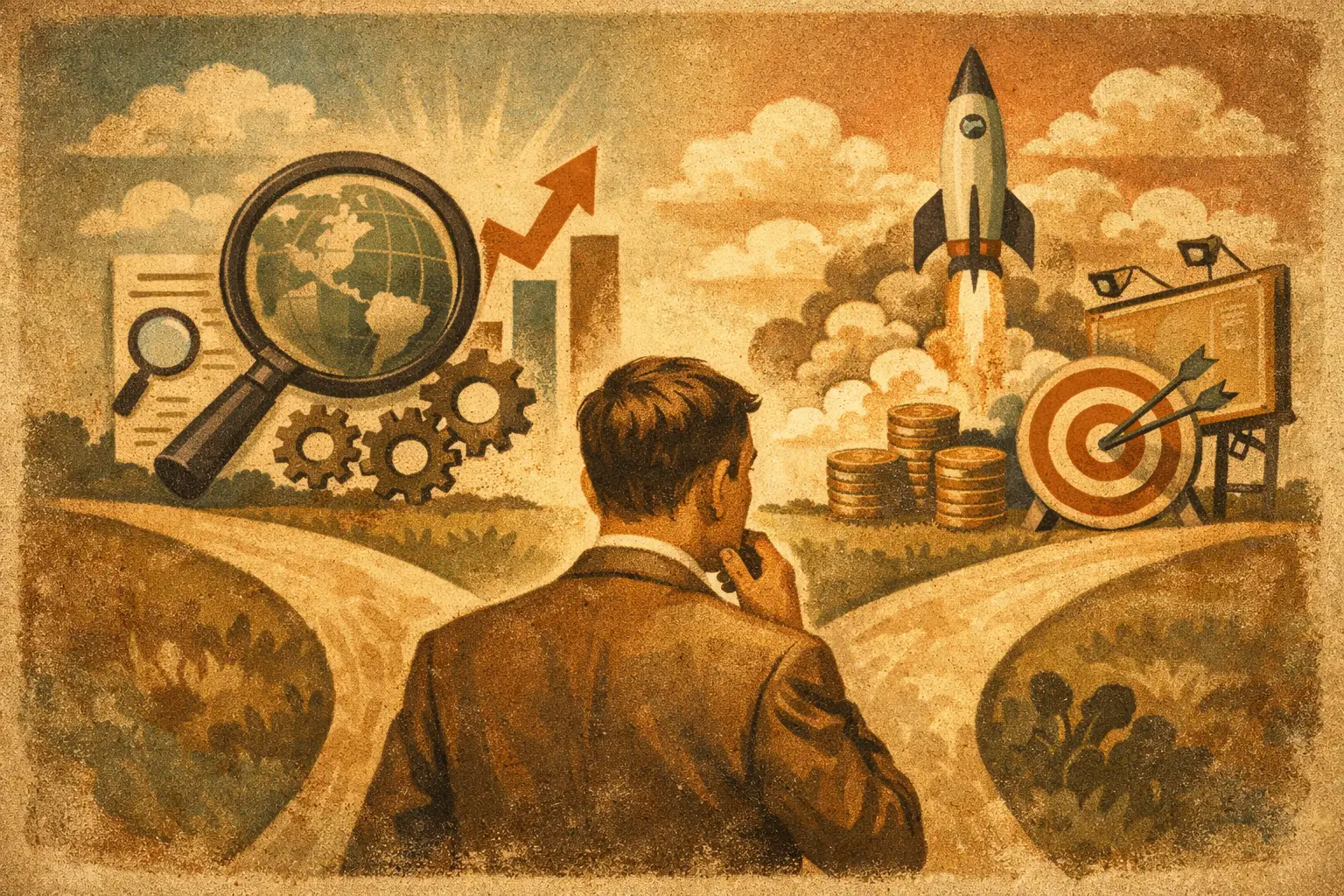
Most business owners ask the wrong version of this question. It is not just seo or paid ads. It is which channel gets you qualified leads faster, which one compounds over time, and which one fits how your business actually sells.
That matters because bad marketing decisions do not fail quietly. They burn cash, waste months, and leave you staring at reports that look busy but do nothing for revenue. If you are trying to grow a real business, the answer is rarely ideological. It is operational.
When people frame seo or paid ads as a simple either-or decision, they usually miss the real trade-off. SEO is a long-game asset. Paid ads are a fast-traction system. One builds momentum over time. The other can put your offer in front of buyers almost immediately.
Neither one is automatically better. The right choice depends on your timeline, margins, sales process, website quality, and how competitive your market is.
If you need leads now, paid ads usually win. If you want a channel that keeps producing without paying for every click forever, SEO has the edge. If you want predictable growth and staying power, most businesses eventually need both.
That is the blunt answer. Now let us get into what actually drives the decision.
SEO is the better bet when your buyers actively search for solutions, your service has steady demand, and you are willing to invest in a channel that gets stronger over time. A local law firm, dental practice, home service business, B2B consultant, or medical clinic can all benefit from showing up when intent is high and the need is immediate.
The upside is obvious. Strong rankings can drive consistent traffic, qualified leads, and lower acquisition costs over the long haul. A good SEO strategy also improves the rest of your marketing. Better content, stronger site structure, and optimized service pages do not just help rankings. They improve conversions.
But SEO is not magic, and it is definitely not fast. If your site is thin, slow, confusing, or built like an online brochure instead of a sales tool, SEO alone will not save it. You can rank and still fail to convert.
SEO also works best when you are willing to build a real system around it. That means technical cleanup, content that matches buyer intent, strong service pages, local optimization where relevant, and a website that can actually turn visits into calls or form fills. If you are looking for instant gratification, this is not your channel.
SEO tends to be the better play if your prospects research before they buy, your sales cycle is not purely impulse-driven, and you want growth that compounds. It also fits businesses that have enough patience to let strategy build traction instead of demanding a miracle by next Tuesday.
If your market has a lot of repeat searches and educational queries, SEO gets even stronger. You are not just capturing demand at the bottom of the funnel. You are shaping it earlier.
Paid ads are the faster option when speed matters, demand already exists, and you need a direct line between spend and lead flow. If you need to test offers, generate leads quickly, launch a new service, or fill a pipeline gap, ads can do that far faster than SEO.
That is why so many growth-focused businesses rely on them. Paid search can capture high-intent buyers right when they are ready to act. Paid social can put your brand in front of targeted audiences before they even start searching. Both can work, but only if the campaign strategy, targeting, offer, and landing experience are tight.
Here is where many businesses get burned. They think ads fail because the platform did not work. In reality, the offer was weak, the landing page was bad, the tracking was sloppy, or the follow-up process was a mess. Paid traffic exposes operational weaknesses fast.
That is not a reason to avoid ads. It is a reason to treat them like a revenue system, not a boost button.
Paid ads usually make more sense if you need leads quickly, have clear conversion tracking, and can handle demand when it comes in. They are also strong when you have a proven offer and want to scale what already works instead of waiting for organic traction.
If your business has strong lifetime value, solid close rates, and a website built to convert, paid ads can become a serious growth engine. If you do not have those pieces in place, the spend can get ugly fast.
The biggest mistake is acting like traffic is the whole job. It is not. Traffic without conversion is just expensive noise.
A lot of agencies sell channels in isolation because it is easier. SEO team here, ads team there, web team somewhere else, and nobody owns the result. That is how you end up with rankings that do not produce leads and ad campaigns that drive clicks with no sales behind them.
The channel matters, but the system matters more. Your website has to function like a 24/7 salesperson. Your messaging has to be clear. Your call to action has to be obvious. Your forms, pages, and follow-up process cannot be working against you.
If those pieces are weak, the question is not seo or paid ads. The question is why you are paying for traffic before fixing the machine that is supposed to convert it.
For many small and midsize businesses, the strongest answer is not either-or. It is sequencing.
Paid ads can drive immediate traffic while SEO builds long-term authority and lowers dependence on paid acquisition over time. Ads give you fast data. SEO gives you staying power. Together, they create balance.
This is especially useful if you are trying to grow without putting your pipeline at the mercy of one channel. If your business depends only on ads, lead flow can stop the second campaigns pause. If you depend only on SEO, growth can feel painfully slow and vulnerable to delays in execution.
Running both channels also creates cross-channel advantages. Paid search data can reveal which keywords convert before you invest heavily in SEO content. SEO insights can uncover high-intent topics worth targeting with ads. Strong landing pages can improve both organic and paid performance.
That is a more serious growth strategy than picking a side and hoping for the best.
Start with timing. If you need demand this quarter, paid ads deserve a hard look. If you can invest with a longer horizon and want sustainable lead generation, SEO likely deserves priority.
Next, look at intent. Are people actively searching for what you sell? If yes, both SEO and paid search can work. If not, you may need paid social or stronger brand positioning before search becomes effective.
Then look at your website honestly. Not politely. Honestly. If your pages are vague, your offer is weak, or your calls to action are buried, neither channel will perform the way it should. More traffic to a bad website just means more people bouncing.
After that, examine your internal follow-up. If leads sit untouched for hours or days, paid ads can become a painful waste and SEO gains can get squandered. Marketing does not stop at the click.
Finally, check your appetite for patience versus speed. SEO requires consistency. Paid ads require active optimization and clean data. One is slower and compounding. The other is faster and more adjustable. Both demand discipline.
A smart plan starts by fixing the foundation first. That means a website built to convert, tracking that tells the truth, offers that match buyer intent, and messaging that speaks like a business owner instead of a marketing textbook.
From there, choose the lead source based on your immediate goal. If you need traction now, launch paid campaigns around your highest-intent services and strongest offers. If you already have some traction and want to build equity, invest in SEO content and page optimization that target the searches most likely to produce revenue.
Then use real performance data to adjust. Not vanity metrics. Not feel-good dashboards. Look at qualified leads, close rates, sales velocity, and which channel actually moves revenue.
That is the mindset QVM Digital Marketing pushes because it is the only one that holds up under pressure. The point is not to collect clicks. The point is to grow.
If your business needs speed, start with paid ads. If your business needs durable visibility, invest in SEO. If you want serious growth, stop treating them like enemies and build a system where each does its job.
The best marketing decisions are not based on hype or habit. They are based on what gets the right people to your site, gets them to take action, and turns that action into revenue. Start there, and the channel choice gets a whole lot clearer.
A weak website or invisible search rankings are lost opportunities. We turn your traffic into measurable revenue with high-performance digital strategies.
Connect With Our Experts218 Henderson Hwy
Winnipeg, MB, Canada
A weak website, low engagement, or invisible search rankings aren’t just problems—they’re lost opportunities. At QVM, we build high-performance websites, results-driven SEO, and content that actually converts.
Connect and discuss