
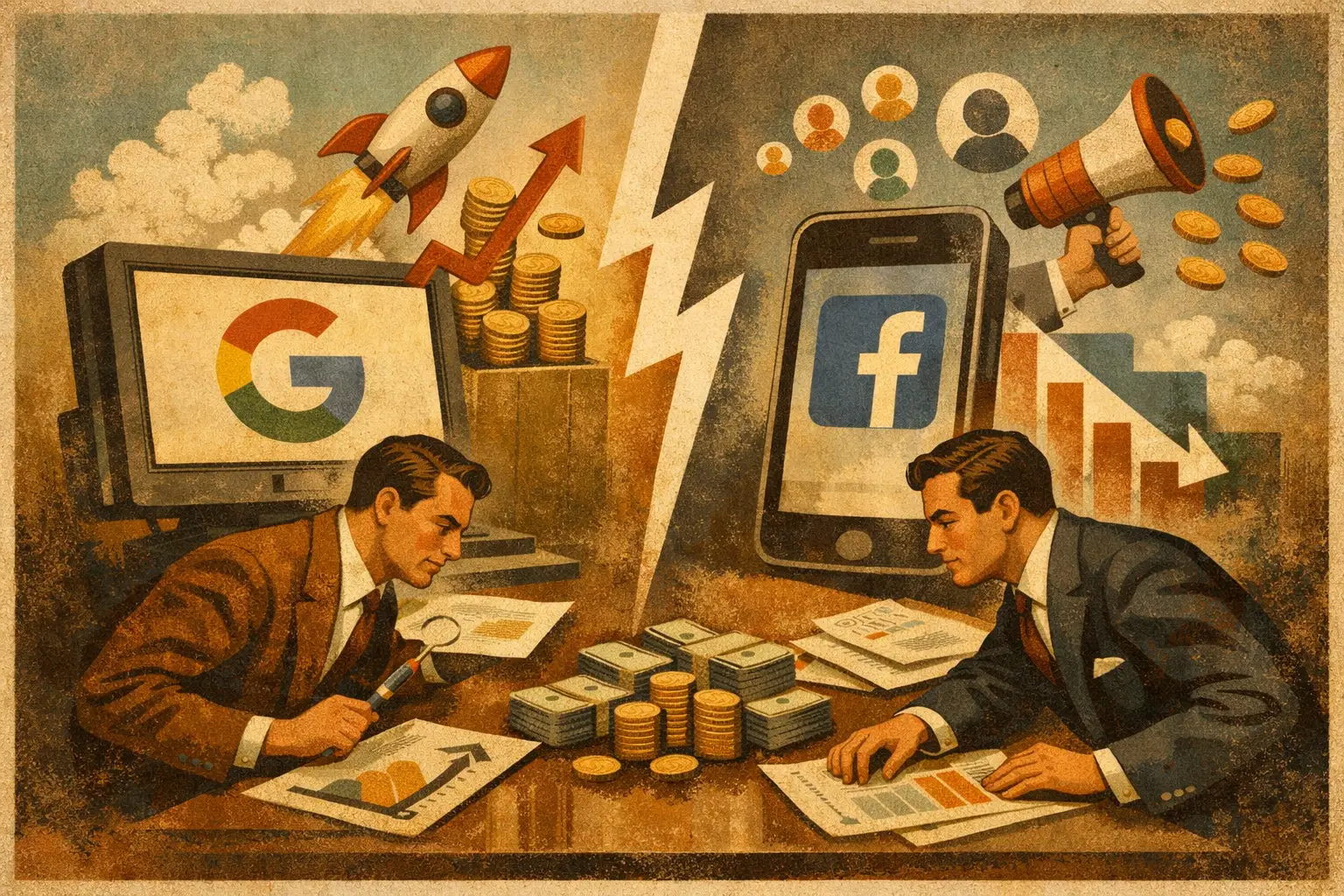
One platform fills your pipeline faster. The other can make your brand impossible to ignore. When business owners ask about google ads vs facebook ads roi, they usually want a simple winner. They rarely get one, because ROI depends on what you sell, how people buy, and whether your funnel is built to convert traffic into revenue instead of just clicks.
That said, there is a practical truth most agencies dance around. Google Ads usually wins when people already know they need something and are actively searching for it. Facebook Ads usually wins when you need to create demand, stay in front of buyers, and move cold audiences toward a purchase over time. If your agency is giving you fluffy answers beyond that, they are probably avoiding accountability.
ROI is not decided by the platform alone. It is decided by intent, sales cycle, offer strength, landing page quality, follow-up speed, and tracking accuracy. If any of those pieces are weak, both platforms can look bad.
Google Ads captures demand. A user searches for a service, product, or problem because they already want a solution. That intent is valuable. It often means higher conversion rates, especially for local services, urgent needs, and high-intent commercial searches. Think legal help, dental services, home repair, B2B software demos, or anything else people actively look for when the pain is real.
Facebook Ads works differently. It interrupts attention instead of harvesting existing demand. That sounds weaker on the surface, but it can be a serious growth engine when your audience is well-defined and your creative is strong. If you sell something people do not wake up searching for every day, Facebook can put the offer in front of the right people before they ever hit Google.
The mistake is judging both channels by the same standard. Search traffic is usually closer to the bottom of the funnel. Social traffic often needs warming up. If you expect cold Facebook traffic to behave like high-intent search traffic, you will call it a failure too early.
Google Ads tends to produce better short-term ROI when the search intent is obvious and the buying window is short. If someone searches for “emergency plumber near me” or “bookkeeping service for small business,” that click is not casual. The user is raising their hand.
For service businesses, this matters. A lot. You are not paying to get noticed by people who might care later. You are paying to get in front of people already looking for a solution now. That is why lead quality from Google Ads is often better, not just lead volume.
Google also performs well when your offer is easy to understand and your value proposition is clear. If the buyer can compare options quickly, a strong ad and a focused landing page can turn search demand into booked calls, form fills, and sales fast.
But Google Ads has its own trap. Click costs can rise fast, especially when markets are crowded or keyword strategy is sloppy. Bad match types, weak negatives, thin landing pages, and poor conversion tracking can drain budget without producing real business results. Search is high intent, but it is not forgiving.
If you want Google to carry ROI, your campaign structure has to be tight. Search terms need to match your offer. Landing pages need to answer the exact query. And your follow-up process has to be fast. A missed call or slow response can erase the advantage of buying high-intent traffic.
Facebook Ads often wins on efficiency when targeting is strong, creative is compelling, and your sales process can nurture interest. It is especially effective for visually driven offers, niche audiences, repeat-purchase products, and businesses that benefit from education before conversion.
This is where a lot of brands underestimate Facebook. They treat it like a direct-response machine without doing the work that direct response requires. On Facebook, the ad creative matters more. The hook matters more. The offer framing matters more. And your retargeting matters a lot more.
Facebook can be excellent for top-of-funnel scale. It lets you build awareness, generate leads, test messaging, and re-engage visitors who did not convert the first time. If your product or service needs trust before action, Facebook gives you more room to build that trust through repetition.
It can also beat Google when there is little search demand for what you sell. People cannot search for a solution they do not yet understand. In those cases, waiting for intent is a losing strategy. You need to create momentum, shape demand, and drive the first touchpoint. That is Facebook’s lane.
The downside is simple. Lower intent usually means more friction. Your conversion rate may be lower on the first interaction. Attribution can be messier. And weak creative gets punished fast. Facebook is not a set-it-and-forget-it platform. If the message is bland or the audience is too broad, ROI can collapse.
A cheap lead that never closes is expensive. A costly click that turns into a high-value customer is profitable. That is why google ads vs facebook ads roi should never be judged on front-end metrics alone.
Business owners get burned when agencies obsess over click-through rates, impressions, or low cost per lead while ignoring what happens after the form fill. Did the lead answer the phone? Were they a fit? Did they book? Did they buy? Did they stay?
Google often produces fewer but more qualified leads because search intent does some of the filtering for you. Facebook can generate leads at volume, but quality control depends heavily on your offer, form strategy, ad messaging, and follow-up.
For example, a short instant form on Facebook may lower lead cost. It may also flood your sales team with weak leads who were curious for three seconds and then disappeared. That is not ROI. That is noise.
The platform matters, but downstream conversion matters more. If your CRM is a mess, your sales process is inconsistent, or your website fails to convert, neither platform will save you.
Start with buyer intent. If your customers actively search for what you sell, Google Ads deserves serious attention. If your audience needs education, emotional persuasion, or repeated exposure before acting, Facebook likely deserves a bigger role.
Then look at your sales cycle. Short-cycle purchases often fit Google better because demand is already present. Longer cycles usually benefit from Facebook because the platform helps you stay visible across multiple touchpoints.
Next, be honest about your creative assets. Google can work with strong copy and smart keyword strategy. Facebook needs better visuals, stronger hooks, and more testing discipline. If your ad creative is weak, Facebook ROI will suffer.
You should also look at your site and landing pages. Google traffic expects relevance and speed. Facebook traffic expects persuasion and trust-building. Sending both to the same generic page is one of the fastest ways to waste budget.
Finally, judge results by contribution to revenue, not channel ego. Sometimes Google closes the sale while Facebook created the awareness. Sometimes Facebook retargeting recovers traffic Google originally generated. The point is not to force one winner. The point is to build a system that turns attention into sales.
If you want blunt honesty, the best answer for many small and mid-sized businesses is not Google or Facebook. It is sequence.
Google captures buyers who are ready now. Facebook builds familiarity with buyers who are not ready yet. Together, they create a stronger acquisition path than either channel running alone. Search picks up high-intent demand. Facebook retargeting brings back non-converters. Social prospecting expands the audience. Search closes the hand-raisers.
This is where integrated strategy beats cookie-cutter campaign management. When channels are connected, you stop asking which platform is better in the abstract and start asking how each platform should do its job inside the funnel.
That is the difference between running ads and building a revenue engine. One chases metrics. The other creates predictable growth.
Do not judge ROI too early. Google can ramp faster, but it still needs search term data, landing page optimization, and conversion tracking dialed in. Facebook often needs more testing time because audience response and creative fatigue change performance.
Do not trust platform-reported results blindly either. Each platform wants credit. What matters is what your actual pipeline and sales data say. If calls are low quality, booked appointments are weak, or closed revenue is flat, the campaign is not working well enough.
And do not ignore the offer. A weak offer on the best platform still loses. If your competitors are clearer, faster, or more credible, ad spend will only expose the problem faster.
At QVM Digital Marketing, this is the part we refuse to sugarcoat. Good media buying cannot fix a broken funnel. But when the message is sharp, the landing page converts, and tracking is clean, both Google and Facebook can move the needle hard.
If you are choosing between the two, start with the channel that matches buyer behavior, not the one with the loudest hype. The best ROI usually shows up when your marketing meets people where they are, then gives them a clear reason to act now.
A weak website or invisible search rankings are lost opportunities. We turn your traffic into measurable revenue with high-performance digital strategies.
Connect With Our Experts218 Henderson Hwy
Winnipeg, MB, Canada
A weak website, low engagement, or invisible search rankings aren’t just problems—they’re lost opportunities. At QVM, we build high-performance websites, results-driven SEO, and content that actually converts.
Connect and discuss