
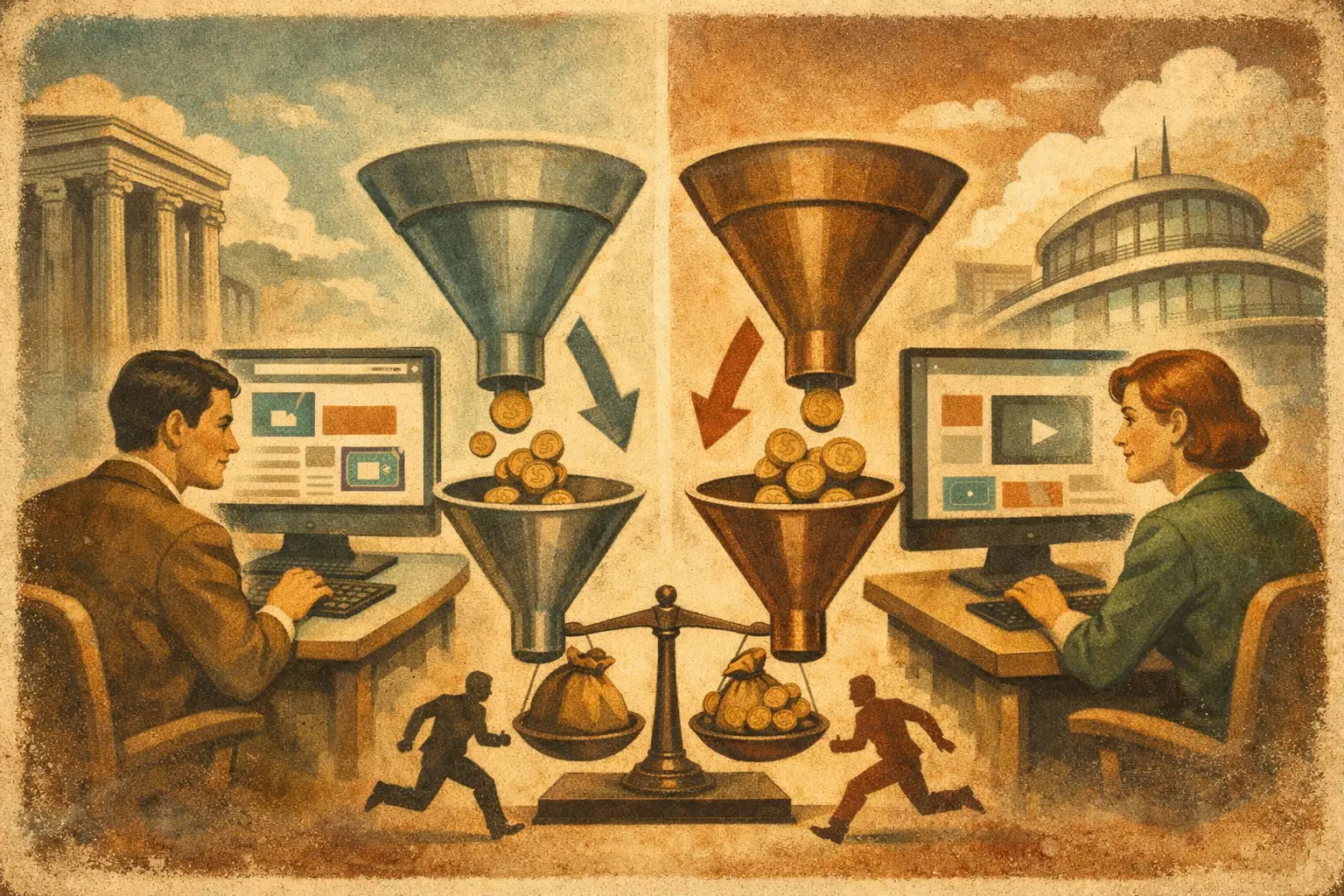
A website can win design awards and still bleed revenue. If pages load slowly, forms create friction, messaging misses the buyer’s real problem, or tracking is broken, your traffic goes nowhere. That is why the WordPress vs Webflow for conversions debate is not really about which platform looks better. It is about which one gives your business the best shot at turning attention into booked calls, form fills, and sales.
The blunt answer: neither platform automatically converts. Strategy converts. Clear positioning converts. Fast pages, persuasive offers, credible proof, and an obvious next step convert. But the platform determines how quickly your team can build, test, measure, and improve those conversion levers without creating a technical mess.
WordPress usually gives growing businesses more flexibility. Webflow usually gives design-led teams more control and fewer moving parts at launch. The better choice depends on how aggressive your marketing plan is and how often you expect your website to evolve.
If your website is a digital brochure that changes once or twice a year, either platform can do the job. If it is supposed to operate as a 24/7 salesperson – supporting SEO, paid traffic, landing pages, lead magnets, service pages, and ongoing conversion testing – the choice deserves more scrutiny.
Do not choose based on a sales pitch about features. Choose based on the work your website needs to do after launch.
Before comparing platforms, get clear on what produces a conversion. A visitor must immediately understand what you do, who you help, and why they should care. Then the page needs to remove doubt with proof, answer objections before they become exit points, and make the next action feel easy.
That means your website needs more than a clean layout. It needs persuasive copy, strong service positioning, relevant testimonials or outcomes, fast load times, mobile-first forms, and tracking that tells you what happens after a visitor clicks.
Platform choice matters because it affects your ability to execute those elements consistently. A beautiful site that is hard to update becomes stale. A flexible site packed with unnecessary add-ons can become slow. Both problems cost leads.
WordPress is often the stronger choice for businesses running an active marketing program. Its biggest advantage is not that it has more options. It is that those options let you build a website around your actual acquisition strategy instead of forcing your strategy into a limited setup.
Need a high-intent service page for organic search? Build it. Need a campaign-specific landing page that speaks directly to a paid ad audience? Build it. Need location pages, case studies, resource content, gated assets, new forms, or a new conversion path after reviewing performance data? WordPress makes ongoing expansion practical when the site is built correctly.
That matters because conversion optimization is never one-and-done. The first version of a landing page is a hypothesis. You watch user behavior, identify where prospects hesitate, tighten the message, reposition the call to action, and test again. Businesses that treat their site as a living sales asset tend to outperform businesses that treat it as a project they finished last year.
WordPress also works well for content-heavy lead generation. When SEO is part of your growth plan, you need a system that can support a growing library of pages without making every update feel like a development request. Publishing content is only useful when it feeds a clear path from search intent to service page to conversion action. WordPress gives marketers room to build that path.
The trade-off is discipline. A poorly built WordPress site can get bloated fast. Too many plugins, weak hosting, oversized images, and sloppy development can damage speed, tracking, and user experience. That is not a WordPress problem. It is an execution problem.
A WordPress site built for conversion needs a lean technical foundation, limited and purposeful tools, image optimization, reliable backups, security maintenance, and regular performance checks. Skip that work, and flexibility turns into friction.
Webflow is a strong option when visual consistency and design control are central to the project. It allows teams to create polished, custom page layouts without relying on a stack of disconnected templates and add-ons. For brands that need every page to feel intentional, that can be a major advantage.
A well-built Webflow site can also support fast, focused marketing pages. Its visual editing environment makes it easier to preserve spacing, hierarchy, and brand standards across a site. That matters for conversions because trust is built in small moments. Inconsistent buttons, awkward mobile layouts, and pages that feel thrown together can make a prospect question whether your business is equally disorganized.
Webflow can be especially effective for businesses with a defined set of services, a smaller content footprint, and a team that values tight design governance. If the goal is a sharp lead-generation site with a controlled number of pages, it can deliver a clean experience without unnecessary complexity.
But Webflow becomes less attractive when your marketing operation needs frequent, high-volume changes or advanced functionality that falls outside its core strengths. You can still build around those needs, but the work may require more specialized support. That can slow down the very testing and iteration that drives better conversion rates.
The key question is not whether Webflow can create a conversion-focused site. It can. The question is whether it will remain easy to adapt six months from now when your ad campaign needs dedicated pages, your SEO strategy expands, and your sales team identifies new objections prospects need answered.
Both platforms can produce fast websites. Both can also produce slow ones. Platform alone does not guarantee strong performance.
For conversions, page speed matters because impatient visitors do not wait around to admire your design. This is especially true for paid traffic. Every slow second wastes part of the budget you already spent to earn that click. Mobile experience matters for the same reason. If a visitor has to pinch, zoom, hunt for a button, or fight with a form, the lead is gone.
Tracking deserves the same level of attention. If you cannot see which pages produce calls, form submissions, qualified leads, and eventual sales, you are managing by guesswork. Vanity metrics such as traffic and page views can make a weak website look busy. Revenue-focused reporting tells you whether the site is doing its job.
Whether you choose WordPress or Webflow, establish conversion tracking before campaigns go live. Track the actions that matter, verify they work, and review the full path from traffic source to lead quality. A form submission that never reaches the right person is not a conversion system. It is a leak.
Choose WordPress when your business needs a flexible growth engine. It is generally the better fit for companies investing seriously in SEO, publishing ongoing content, building multiple landing pages, and making regular conversion improvements based on campaign data. It gives you more room to grow without rebuilding the entire site when your marketing gets more ambitious.
Choose Webflow when design precision, brand control, and a more contained website structure are the priority. It is a smart fit when your team needs a polished site with fewer moving parts and you do not expect constant structural changes or a large-scale content operation.
There is no prize for choosing the platform with the loudest fan base. The win is choosing the platform your team can maintain, your marketing can scale, and your prospects can use without friction.
Too many businesses start with colors, animations, and homepage mockups. Start with the sales process instead. What problem brings a visitor to the page? What offer matches that problem? What proof will make them believe you can deliver? What action should they take next, and what happens after they take it?
Those answers should shape the site architecture, page copy, calls to action, forms, and follow-up process. The platform comes after that. WordPress and Webflow are tools. Neither can rescue a vague offer, weak positioning, or a lead response process that moves too slowly.
Build the site around measurable buyer behavior, then keep improving it. The businesses that convert more do not guess what prospects want. They track the friction, fix it, and make the next decision easier.
A weak website or invisible search rankings are lost opportunities. We turn your traffic into measurable revenue with high-performance digital strategies.
Connect With Our Experts218 Henderson Hwy
Winnipeg, MB, Canada
A weak website, low engagement, or invisible search rankings aren’t just problems—they’re lost opportunities. At QVM, we build high-performance websites, results-driven SEO, and content that actually converts.
Connect and discuss